A First Somatic Cell Aging Model for Systems Beyond
A Boolean network for proliferation, apoptosis and senescence — our first computational prototype of a somatic cell, and the logic that drives its fate decisions.
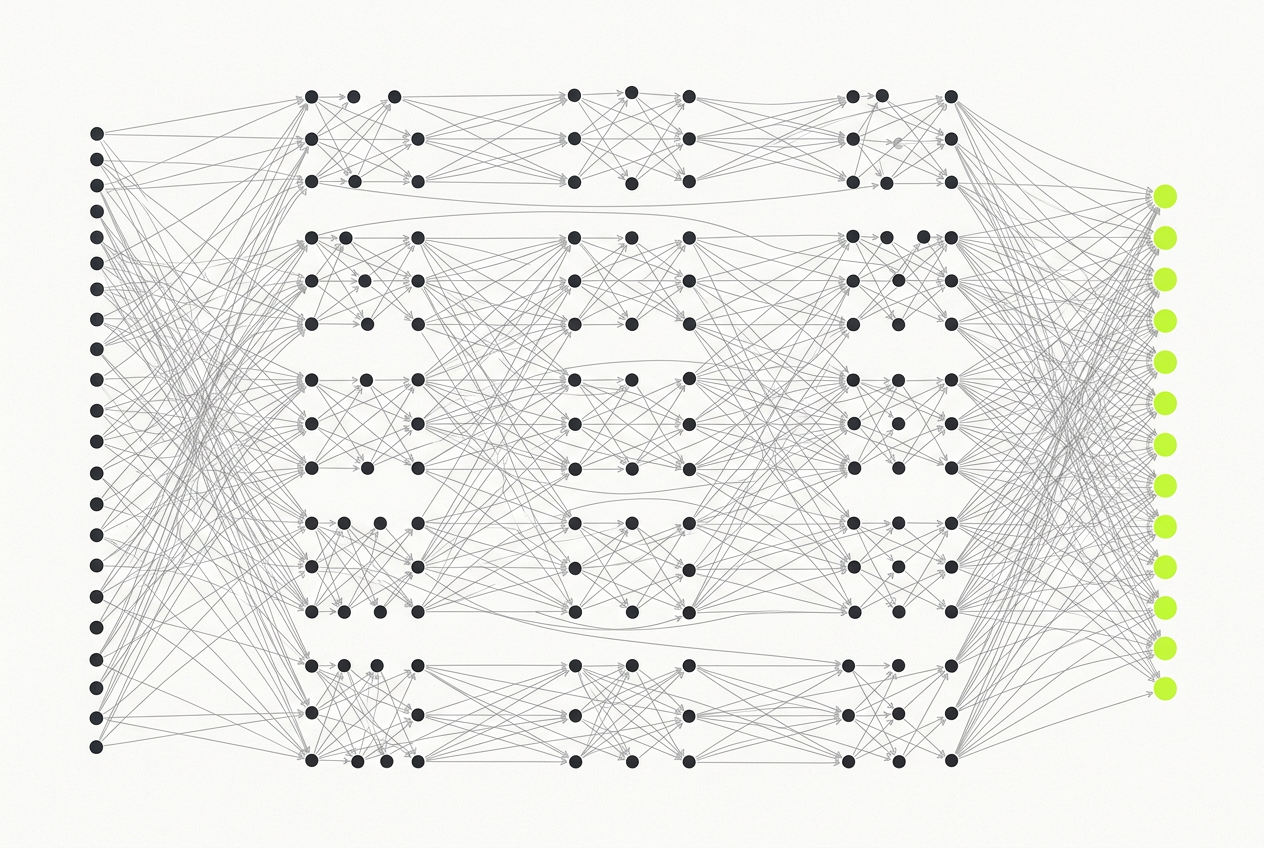
Aging doesn't happen in one organelle or one pathway. It emerges from how nutrient sensing, stress responses, DNA damage and inflammatory signals talk to each other over time. To even start asking serious "what if?" questions (caloric restriction, rapamycin, NAD⁺, anti-inflammatories) we need a generalizable somatic-cell model, not one tied to a specific tissue or disease.
The model presented here is our first computational prototype of such a cell within Systems Beyond:
- It's mechanistic enough to include key players (mTOR, AMPK, ROS, DDR, p53, NF-κB).
- It's simple enough (Boolean logic) to explore whole-network dynamics, attractors and basins of attraction.
- It can already express three essential fate outcomes: proliferation, apoptosis, and senescence + SASP.
This is Model v1.0: a starting point for systematic refinement, not a final "truth".
The model structure in a nutshell
The Boolean aging network is a qualitative cell-fate simulator. It does not calculate concentrations or reaction rates. Instead, every node is treated as ON/OFF, and the whole cell state evolves step by step until it reaches a stable pattern called an attractor. The model separates nodes into inputs, signaling, metabolic, stress/damage/protection, and cell-fate outputs. The final fate nodes are APOPTOSIS, SENESCENCE, SASP and PROLIFERATION.
The big idea of the network
Given a cellular environment — nutrients, growth factors, DNA damage, ER stress, inflammation, hypoxia, matrix contact and oxidative stress — does the cell settle into proliferation, senescence, apoptosis, SASP, or a protected/adaptive state?
So the model is basically a decision machine for cellular aging.
1. Environmental inputs
NUTRIENTS      GF            MATRIX
DNA_DAMAGE     ER_STRESS     OX_STRESS
HYPOXIA        INFLAM_ENV
This is the "world" the cell lives in. NUTRIENTS tells the model whether the cell has energetic/building resources; GF means growth factors are present; MATRIX means extracellular matrix contact; and DNA_DAMAGE, ER_STRESS, OX_STRESS, HYPOXIA and INFLAM_ENV are stressors.
2. Growth-factor and adhesion signaling
The first internal decision is whether the cell receives growth permission.
GF     → RTK
MATRIX → INTEGRIN
RTK / INTEGRIN → PI3K / PDK1 → AKT
When this axis is ON, the model activates AKT, which then supports MTOR, BCL2 and eventually PROLIFERATION — as long as stress checkpoints are not active.
3. mTOR, metabolism and growth capacity
The metabolic layer is the core "growth versus conservation" switch. When the cell has AKT = ON, NUTRIENTS = ON and AMPK = OFF, then MTOR = ON and MTORC1 = ON. MTORC1 then supports HIF1A, GLYCOLYSIS and PROLIFERATION.
But if stress activates AMPK, then AMPK suppresses the mTOR/proliferation axis — a shift from "build and divide" toward "protect, repair, conserve."
The stress-response system
Our model has an important stress-damage core: ROS, DDR, P53, P21, P16_RB, AUTOPHAGY, FOXO, NRF2, SIRTUIN and AMPK.
ROS as a central amplifier. ROS turns on when there is oxidative stress, mitochondrial dysfunction, or inflammatory activation:
ROS = OX_STRESS OR poor MITO_FUNC OR inflammatory NFKB
Once active, ROS feeds NFKB, LKB1/AMPK, DDR, P16_RB, APOPTOSIS and SENESCENCE. It is one of the main damage-amplifier nodes.
Protection. The adaptive branch works like this:
Stress → LKB1 / AMPK → SIRTUIN → FOXO
ROS → NRF2
AMPK / FOXO / NRF2 / SIRTUIN → AUTOPHAGY
The key protective output is AUTOPHAGY, which supports mitochondrial function and reduces damage propagation. A crucial design choice is that ROS alone does not fully push the cell into damage response if autophagy can handle it:
DDR = DNA_DAMAGE OR (ROS AND NOT AUTOPHAGY)
The cell-fate decision logic
The four final fate outputs compete with each other.
Proliferation requires strong growth and metabolic permission with no active checkpoint:
PROLIFERATION =
  RTK AND INTEGRIN AND MTORC1 AND GLYCOLYSIS
  AND NOT P21 AND NOT P16_RB
  AND NOT APOPTOSIS AND NOT SENESCENCE
Senescence depends on damage plus MTORC1:
SENESCENCE = P53 AND (DDR OR ROS) AND MTORC1
             OR previous SENESCENCE maintained by damage/inflammation
It means senescence is not simply "damage" — it is damage plus survival/growth metabolism. Senescent cells are not dead: they are metabolically active, damaged, arrested and often inflammatory.
Apoptosis is the self-maintaining death decision:
APOPTOSIS = P53 AND (DDR OR ROS) AND NOT BCL2 AND NOT MTORC2
            OR previous APOPTOSIS maintained by P53
SASP requires senescence plus inflammatory signaling:
SASP = SENESCENCE AND NFKB OR previous SASP maintained by SENESCENCE
So the model distinguishes "senescent but quiet" from "senescent and inflammatory" — biologically useful, because not every senescent state has the same inflammatory output.
Why our model is good as a complex-systems model
The important thing is not the individual pathways but that the network has feedback, memory and attractors. The simulation keeps a history of states and checks when a state repeats; if it repeats, the model identifies an attractor (a fixed point or a limit cycle) and reports attractor type, length and steps to attractor.
That makes it a complex-systems representation of aging, because aging is modeled not as one linear pathway but as a state-space transition problem:
initial condition + environment → dynamic trajectory → attractor / fate
The cell does not merely "activate pathway X." It moves through a network of mutually constraining decisions until it stabilizes into a fate.
The essence of the model
Our Boolean aging network represents a somatic cell as a dynamic decision system balancing growth, metabolic sufficiency, stress adaptation, DNA-damage response and cell-fate commitment. If damage dominates, the system exits proliferation and settles into apoptosis, senescence or inflammatory SASP depending on whether survival/growth metabolism and inflammatory signaling remain active.
That is the essence of our model: aging as a shift in the attractor landscape from a proliferative attractor toward damage-stabilized attractors such as senescence, SASP or apoptosis.